

Bioenergy village
Your path to energy independence
Local heat from renewable energies for villages and municipalities. Make yourself energy-independent and climate-neutral.
Energy supply
The future model: independent energy supply
Today’s crises confront us all with energy challenges. Oil and gas have never been as expensive as they are now, due to import dependencies. The German government is responding to climate change with the Buildings Energy Act (GEG). It is high time to switch to economically and ecologically sensible energy sources and to use sustainable solutions. With your own renewable energy supply, you gain energy independence as a bioenergy village and contribute to the energy transition.
We rely on state-of-the-art technology, and thus offer you and your citizens the best possible solution.
Markus Lenhart
Managing director
Supply concepts
Solutions for your energy independence
Sustainable, future-proof and economically sound solutions.
Local heating network
Energy is transported as heat in the form of heat from a climate-friendly fired local heating centre through a distribution network to the citizens’ house stations. In the return line, cooling is also possible using a heat exchanger.
Cold local heating network
Energy extracted directly from ground probes is delivered as low-temperature heat through a ring main to the citizens’ households and raised to the desired temperature level using heat pumps. In summer it can also be used for cooling.
Local heating plant
Climate-friendly energy is generated in a local heating centre, fired with various renewable plant technologies. Depending on local conditions these are biomass or combined heat and power plants, complemented by wind, geothermal or solar thermal installations.
Combined heat and power plant
Using combined heat and power, electrical and thermal energy are generated simultaneously in a climate-friendly local heating centre. Surplus electricity can be fed into the public grid, and the heat produced in parallel serves space heating and hot water preparation.
Municipality & residents
Your benefits as a bioenergy village
Let your municipality and its citizens benefit from independent energy supply.
Benefits for municipalities
- Independence
- Local infrastructure
- Jobs
- Regional value creation
- Tax revenue
- Funding from federal and state government
Benefits for citizens
- Citizen participation
- Savings on energy prices
- Price stability
- Security of supply
- Extra space, since no own heating system and no oil tanks are needed
- Use of green energy
Reference project
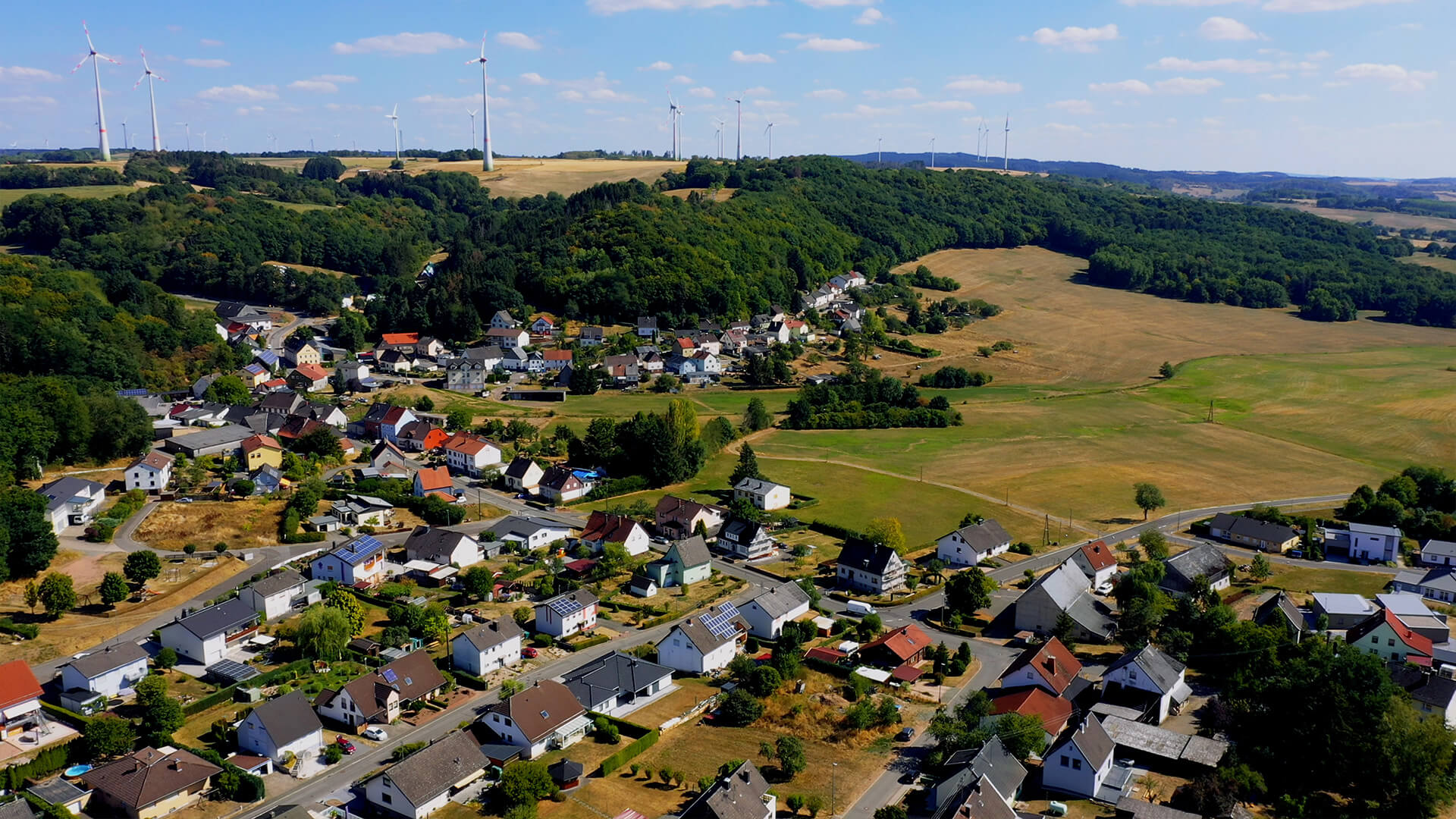
Bioenergy village Gimbweiler
Local heating network as a complete solution
For Gimbweiler in Rhineland-Palatinate we implemented a bioenergy village: a local heating centre fired with wood chips and supported by solar thermal energy. A decentralised local heating network distributes the generated energy to the municipality’s households via customer transfer stations.
To renewable energies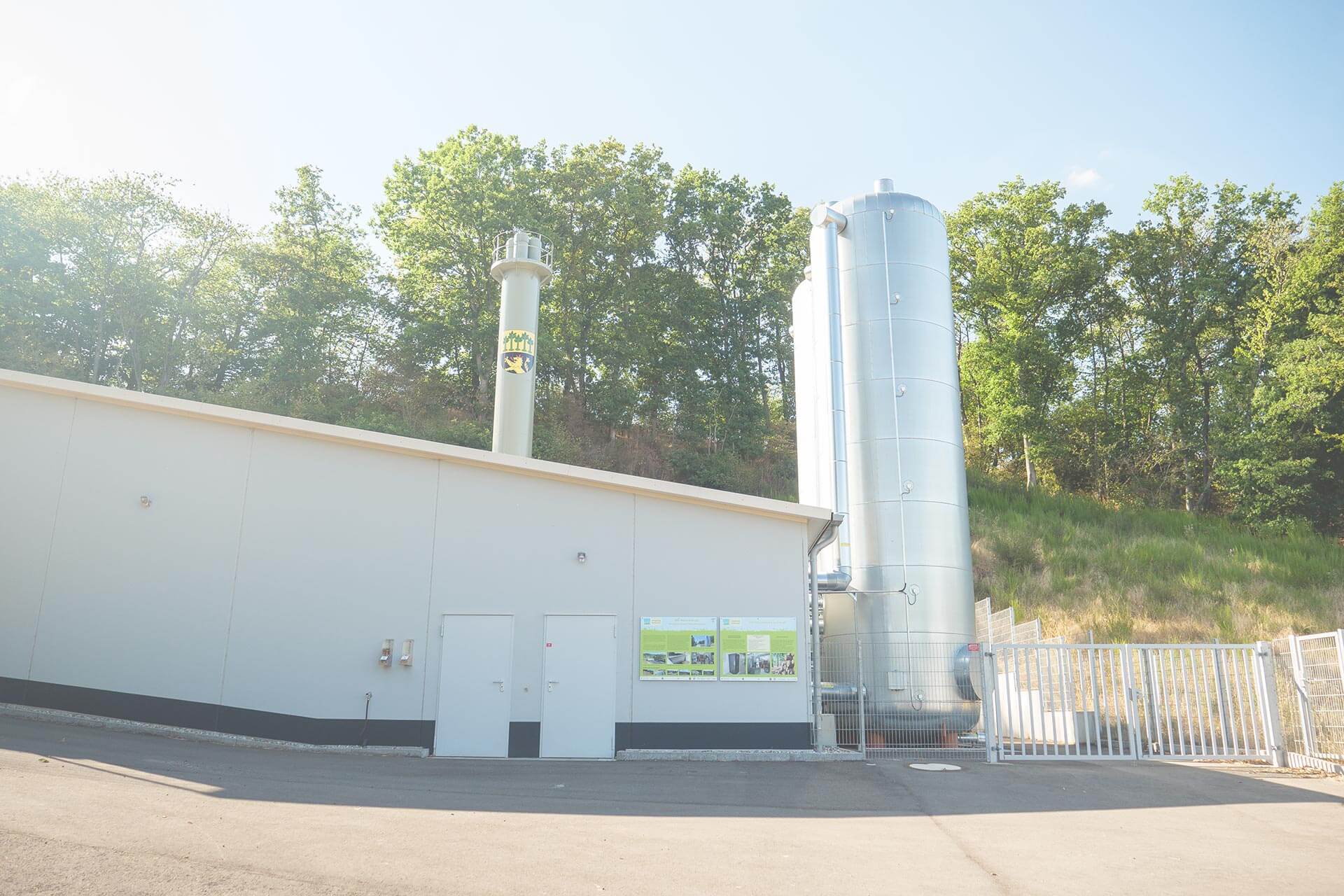
Frequently asked questions
Planning and implementing a bioenergy village
A bioenergy village aims to convert the majority of its heat and electricity supply to renewable energies. It covers at least 50% of its energy needs from regionally produced bioenergy. Citizens are involved in decision-making processes and actively carry the idea of the bioenergy village forward. The bioenergy installations are at least partly owned by the consumers, farmers or foresters on site.
The federal government supports both the expansion of local heating networks with renewable energies and expansion based on combined heat and power technology. In addition, the state of Rhineland-Palatinate promotes local heating networks with investment incentives through its future-proof energy infrastructure funding program (ZEIS). Furthermore, a promotional loan for renewable energies premium with a repayment bonus for heat can be applied for at the KfW bank.
Depending on the energy mix, security of supply is ensured by several installations that complement or substitute one another. As a rule, a very large buffer storage is also present. This provides a very high degree of failure safety, significantly higher than with a single oil boiler in a private household, which normally has no replacement. In addition, an emergency service is on call for faults.
To assess feasibility, a feasibility study is commissioned with an engineering firm. Its purpose is to verify the technical and in particular the economic viability of the project. To finance the feasibility study, public funds are raised along with a small personal contribution, for example 100 to 200 euros per household ready to be connected.
If a feasibility study shows positive results, working groups must be formed within the municipality. One of them deals with founding a preparatory company, which prepares the later operating company that will eventually run the bioenergy installations. It drafts preliminary contracts for heat customers and preliminary supply contracts for farmers and foresters, presents them at a shareholders’ meeting and has them adopted. Once adopted, a preliminary planning study is commissioned to ensure that the prices set for heat customers are really achievable. If they are, the implementation phase begins.
The operating company commissions a competent engineering firm with the design and execution planning. The design planning establishes the technical basis for the approval application. Whether the prepared building application is submitted is decided by the full assembly of the operating company. The execution planning contains the documents for tendering the network and plant construction. Once approvals have been granted and financing is in place, the construction work can be tendered. To reduce complexity and warranty issues, cooperation with a general contractor is recommended.
Contact
Talk to us
Interested in independent energy supply? We will be happy to advise you personally.
24/7 reachable